
Wire Harness vs Cable Assembly: What Is the Difference?
Introduction
When selecting a wiring solution for electronic equipment, industrial machines, or automation systems, many engineers and buyers often ask:
What is the difference between a wire harness and a cable assembly?
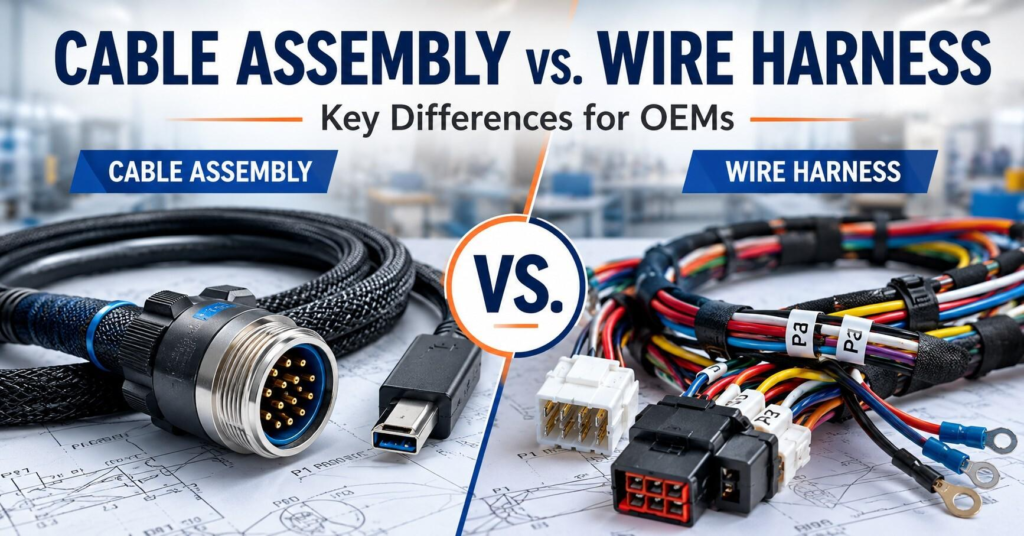
Although these two terms are sometimes used interchangeably, they have different structures, manufacturing processes, and application purposes.
Understanding the differences can help engineers choose the right wiring solution, improve product reliability, and reduce unnecessary design costs.
As a professional wire harness manufacturer, Fengzhan Electronics provides customized wire harness assemblies and cable assembly solutions for various industries, including industrial equipment, automation systems, electronic devices, and custom OEM applications.
What Is a Wire Harness?
A wire harness is an organized assembly of multiple individual wires, terminals, and connectors combined together to transmit electrical power or signals.
The main purpose of a wire harness is to simplify wiring installation, improve organization, and provide reliable electrical connections inside equipment.
A typical wire harness may include:
- Electrical wires
- Terminals
- Connector housings
- Protective sleeves or tubing
- Labels and clips
- Customized routing structures
Wire harnesses are commonly used inside:
- Industrial equipment
- Control systems
- Robotics
- Consumer electronics
- Automotive and transportation equipment
For example, products such as JST cable assemblies, Molex wire harnesses, and custom terminal wire assemblies are widely used where compact and reliable internal wiring is required.
What Is a Cable Assembly?
A cable assembly is a group of wires or cables combined with connectors and often includes additional protection such as shielding, jackets, or insulation layers.
Compared with a standard wire harness, a cable assembly is usually designed for more demanding environments where mechanical protection, signal integrity, or external connection reliability is required.
A cable assembly typically includes:
- Multi-core cables
- Connector plugs
- Overmolding or protective jackets
- Shielding layers
- Strain relief components
Common applications include:
- Power connection systems
- Communication equipment
- Medical devices
- Industrial control equipment
- Testing instruments
Wire Harness vs Cable Assembly: Key Differences
| Feature | Wire Harness | Cable Assembly |
|---|---|---|
| Main Purpose | Organize and connect multiple wires | Provide protected cable connections |
| Structure | Multiple wires with terminals and connectors | Cables with connectors and protective layers |
| Protection Level | Usually for internal equipment wiring | Designed for external or harsh environments |
| Flexibility | High flexibility for complex routing | Better mechanical protection |
| Cost | Generally more economical | Usually higher due to additional materials |
| Application | Internal wiring systems | External connections and demanding applications |
Manufacturing Differences
Wire Harness Manufacturing Process
Wire harness production usually includes:
- Wire cutting and stripping
- Terminal crimping
- Connector insertion
- Electrical testing
- Assembly inspection
The focus is on:
- Accurate wiring
- Reliable crimping
- Correct pin configuration
- Consistent production quality
Cable Assembly Manufacturing Process
Cable assembly production may include additional processes:
- Cable preparation
- Connector installation
- Shielding process
- Jacket or sleeve installation
- Electrical performance testing
The focus is on:
- Cable protection
- Signal stability
- Mechanical durability
- Environmental requirements
How to Choose Between Wire Harness and Cable Assembly?
Choosing the right solution depends on your application requirements.
Choose a Wire Harness When:
A wire harness is suitable when you need:
✔ Multiple wires organized inside equipment
✔ Compact wiring solutions
✔ Customized connector configurations
✔ Cost-effective internal connections
✔ Easy installation and maintenance
Typical applications:
- Industrial control panels
- Robotics equipment
- Electronic devices
- Smart home products
Choose a Cable Assembly When:
A cable assembly is preferred when you require:
✔ Additional mechanical protection
✔ Longer-distance connections
✔ Shielding against interference
✔ External equipment connections
✔ Higher environmental resistance
Typical applications:
- Industrial machinery
- Communication systems
- Testing equipment
- Power systems
Custom Wire Harness and Cable Assembly Solutions
Selecting the right wiring solution is only the first step. A reliable manufacturing partner can help optimize:
- Connector selection
- Wire gauge
- Cable length
- Pin configuration
- Terminal specifications
- Testing requirements
At Fengzhan Electronics, we provide customized wire harness and cable assembly solutions based on customer drawings, samples, or application requirements.
Our capabilities include:
- JST connector wire harnesses
- Molex connector assemblies
- Terminal wire assemblies
- Custom OEM wiring solutions
Whether you need a prototype or volume production, our engineering and manufacturing teams support customers with reliable wiring solutions.
Frequently Asked Questions (FAQ)
1. Is a wire harness the same as a cable assembly?
No. A wire harness mainly organizes multiple wires and connectors for internal wiring applications, while a cable assembly usually includes additional protection and is designed for more demanding connection environments.
2. Which is better, wire harness or cable assembly?
Neither solution is universally better. The right choice depends on application requirements such as protection level, installation environment, electrical performance, and cost considerations.
3. Can a wire harness be customized?
Yes. Wire harnesses can be customized according to wire length, connector type, pin configuration, wire gauge, terminal requirements, and application conditions.